

Jo Peel: London Prints for a City That Won't Sit Still
A primer on the Sheffield-born printmaker drawing London's cafés,
towers and building sites before the cranes get there.
There's a specific kind of London that disappears the second you stop paying attention. The greasy-spoon facade that was there last week. The estate that's "being modernised". The Brick Lane bagel place at 3am that somehow still exists. Jo Peel has spent years drawing it before the developers do. If you don't already know her work, this is the easy entry point. If you do, here are the prints worth looking at on Atom right now.
Who is Jo Peel?
Jo Peel is a Sheffield-born painter, printmaker, animator and filmmaker who studied Illustration at Falmouth and has been showing and selling work since the late 2000s. The throughline of everything she does is urban change — the way a city quietly rewrites itself when nobody's watching, and what gets paved over in the process. Her
drawings tend to lock down the unglamorous bits: scaffolding, shopfronts, half-built blocks, the back of a tower seen from the wrong side of the road.
She's worked with clients including Chanel, the Southbank Centre and Queen Elizabeth Olympic Park, and shown at venues like the Millennium Gallery in Sheffield and Ben Oakley Gallery in London. So the work plays at scale, but the prints are where it actually lives.
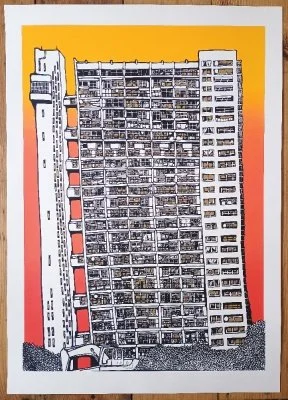
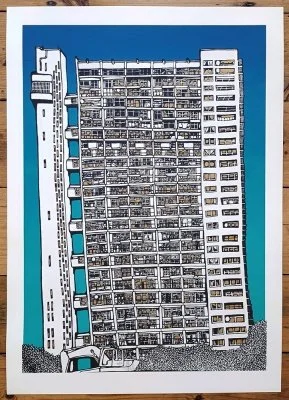
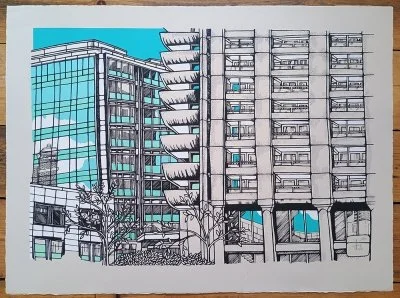
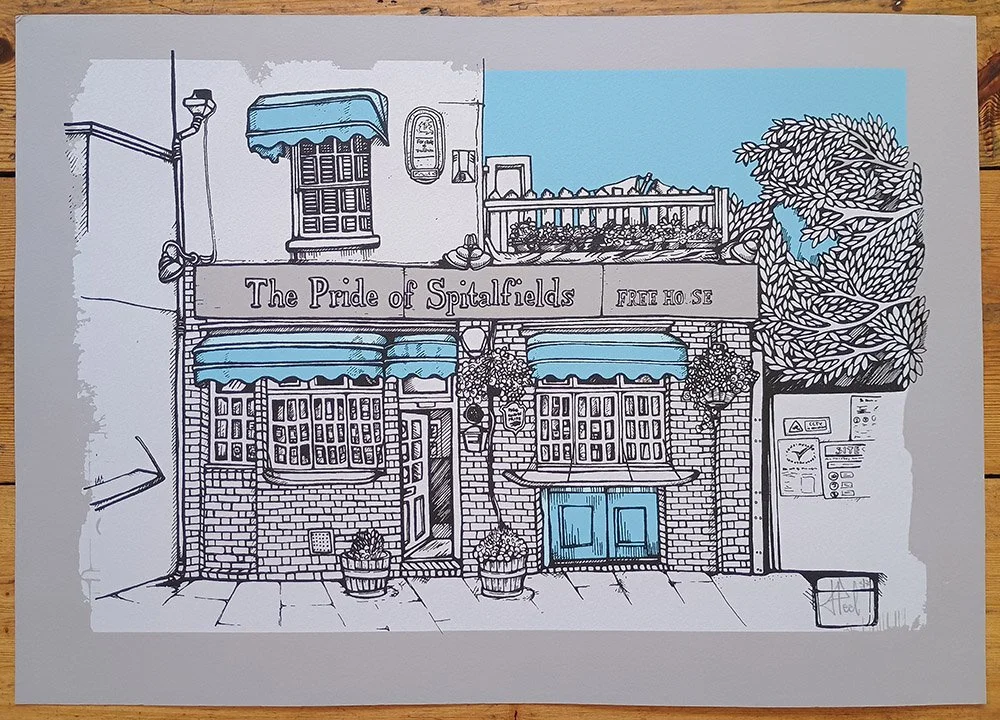
Peel's London catalogue at Atom is essentially a paper map of places real people care about. Beigel Bake on Brick Lane. E Pellici, the listed Italian café in Bethnal Green that's been feeding the East End since 1900. Olympic Park in pink. The Barbican, drawn like brutalism finally got the soft lighting it deserves. Trellick Tower in different colourways — Northern Lights, Tequila Sunrise — Erno Goldfinger's much-fought-over slab, rendered as a cult object rather than a planning row.
The trick with Peel is that she's not selling postcards. The line work is precise, the colour blocks are flat and confident, and the framing tends to crop the city in places that feel lived-in rather than touristy. Hang one of these and it'll out-pretty most "London at night" stock photography on sight.
Why this kind of print actually holds up at home
A lot of city prints look great in the gallery and dead on the wall. Peel's don't, mostly because she's drawing places people have a personal relationship with. Anyone who's queued for a salt beef bagel at 4am or had pie and mash at Pellici brings their own memory to the print, which does half the heavy lifting that art is supposed to do.
They also play well with how people actually decorate now: a graphic limited-edition screenprint sits comfortably above a sofa, in a hallway, in a kitchen, in a small flat where you don't have room for an oil painting and don't want one anyway. Frame it properly and it punches way above its price tag.
Where to start
If you're new to Peel, pick the place you actually go to. The Brick Lane print if that's your patch, the Trellick if you grew up west, Pellici if you're East. If you're collecting more deliberately, look at the screenprints with the more limited editions and the original works on her artist page. Atom carries both, and the artist page is the cleanest way to see what's currently in.
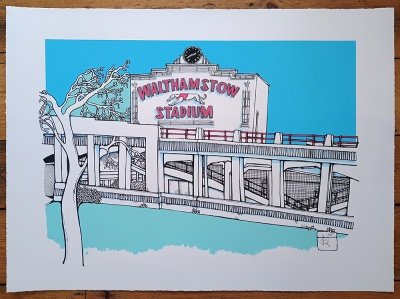
A large-scale screen print celebrating the iconic Walthamstow stadium, featuring a vibrant 5-colour design on luxurious cotton paper. Signed and numbered by the artist.
Artist Jo Peel
Size 76 X 56 cm
Medium screenprint
Edition Size 30
Year 2022